
24V system component
Preparing the weekly product focus…
The official catalogue is being checked for current stock.
—↗
24V wind · battery charging · off-grid power
Select the turbine, wind controller, battery bank and inverter as one electrical architecture. This independent English guide combines practical checks with products read automatically from the official Le Comptoir Éolien catalogue.
The official catalogue is being checked for current stock.
Compatibility worksheet
This calculator is a planning aid, not a substitute for the manuals, protective-device ratings or a qualified installation assessment.
Choose a selection path
Weekly 24V system selection
Priority is given to in-stock 24V kits, turbines, wind control, battery storage and DC-to-AC conversion. The order changes weekly without changing the technical theme.
Focused product finder
Preparing eligible products…
Technical decision guide
At the same power, doubling DC voltage halves the simple current calculation. A 1,200W load is 50A at 24V before losses, compared with 100A at 12V. Cable length, allowable voltage drop, conductor installation, temperature and protection still have to be calculated for the real circuit.
Open the official cable-section toolTwo matched 12V batteries in series produce a 24V bank while amp-hours remain unchanged. Parallel strings increase capacity but make current sharing, fuse placement and balanced cabling more important. Never assume a battery's BMS permits series or parallel operation.
List appliance watts and operating time to estimate Wh/day. Then check the inverter's continuous rating, its stated surge profile, the battery's discharge-current limit and the DC protection. Wind production must be assessed separately because rated power is not a daily-energy promise.
Stay at 12V for compact, low-power systems with short conductors and native 12V equipment. Consider 48V as continuous power, cable distance or storage scale increases. Architecture changes are system-wide: turbine, controller, battery, charger, inverter and protective devices must all accept the selected DC voltage.
Ask about product compatibilityWhere 24V often fits
The installation remains site-specific. Turbulence, mast position, wiring distance, battery limits and seasonal demand can change the result.
Prioritise corrosion-resistant installation practice, noise expectations, safe stopping, controller location and short protected battery runs.
Balance lighting, communications, pumps and occasional 230V loads against usable storage and the site's actual wind conditions.
Confirm whether the vehicle architecture is genuinely 24V, account for space and mass, and isolate renewable charging from incompatible vehicle circuits.
Start from daily Wh and required autonomy, then combine wind and solar only through controllers designed for the shared battery architecture.
Official technical resources
Use the main shop's guides for wind assessment, cable sizing, solar integration and product-specific information.
24V system FAQ
The answers below use cautious engineering checks. The product manuals and the rules applicable to the installation remain decisive.
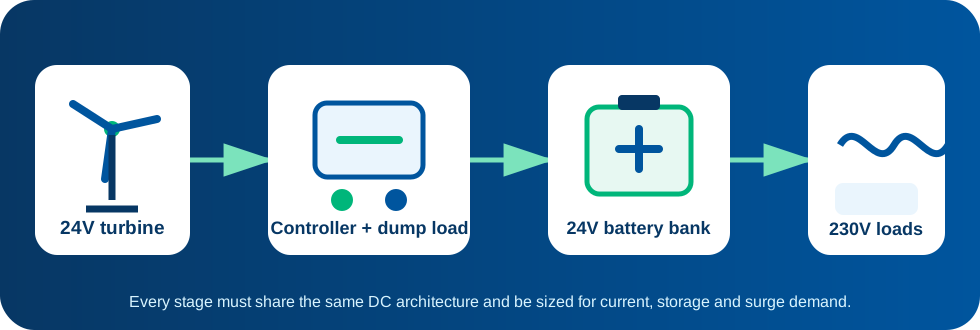
Open the complete official FAQA typical battery-charging architecture includes a 24V wind turbine, a wind controller matched to the turbine and battery chemistry, the controller's specified diversion or braking arrangement, a protected 24V battery bank, suitable DC cabling and protection, and a 24V-to-230V inverter when AC appliances are required.
Divide electrical power in watts by the nominal DC voltage. A 600W rating divided by 24V is 25A as a simple nominal-current check. Real voltage, controller behaviour and output vary, so the controller and cable must follow the manufacturer's limits rather than this calculation alone.
Two compatible 12V batteries connected in series form a 24V bank while the amp-hour capacity remains that of one battery. Use matched batteries approved for series operation, with the same chemistry, capacity, condition and age, and follow the battery manufacturer's wiring and protection instructions.
Nominal energy is voltage multiplied by amp-hours. A 24V 100Ah bank is therefore about 2,400Wh nominal. Usable energy is lower and depends on battery chemistry, permitted depth of discharge, temperature, ageing, wiring and conversion losses.
Motors, pumps, compressors and some electronic power supplies can draw a brief starting load above their normal running power. The inverter, battery, fuses and cables must support both continuous demand and the manufacturer's stated surge conditions.
A 12V architecture may suit a compact installation with modest power, very short DC runs and equipment already designed for 12V. As power or cable length increases, the higher current can make voltage drop and conductor sizing more demanding.
For higher continuous power, long DC cable runs or a larger battery and inverter system, 48V can reduce current for the same wattage. Changing architecture requires every DC component to be compatible; a 24V turbine or controller cannot simply be connected to a 48V bank unless the manufacturer explicitly allows it.
Do not assume direct connection is acceptable. Small wind systems normally require the specified controller, braking or diversion arrangement and protection because the source can continue producing when the battery is full. Use the wiring method and safety devices stated for the exact turbine and controller.
From compatibility to current stock
Prices, availability, contractual descriptions, delivery terms and checkout remain centralised on comptoireolien.fr.